In Search Of Perfect Pitch
How to create a whistle with perfect pitch?
I can mold a whistle and carve out some finger holes but what if I want my whistle to play an actual tune/song? Do-Ra-Me-Fa-So-La-Te-Do (an Octave)
This webpage is dedicated to my experiments to understand whistle frequency/pitch versus several factors:
How does interior volume of the whistle affect sound?
How does finger-hole size affect whistle sound?
Let us begin our technical journey.
Pitch (all finger holes covered) versus Whistle Volume
We know that a large whistle body produces a deep
(low frequency) sound. What is the precise relationship?
I used a set of 5 whistles: 3 are from my collection
and 2 are hand-made greenware (air dried clay).
To measure pitch/frequency, I am using an FFT iPhone App called "Spectrum".
To measure the interior whistle volume, I am filling the whistles with water and dumping this water into a graduated cylinder (to measure this volume).

Fortunately, there is a very clear inverse relationship:

Pitch Changes versus Whistle Finger Hole Size
We know that finger holes in the whistle body produce higher pitch (higher frequency) sound. What is the precise relationship?
Consider this small Platypus whistle (purchased at a Santa Fe market):

There are 4 finger holes of various sizes for a total of 14 possible combinations of total finger hole sizes.
Here is a table of whistle frequency versus finger hole combination.

Pitch/frequency increases linearly with with finger hole area.
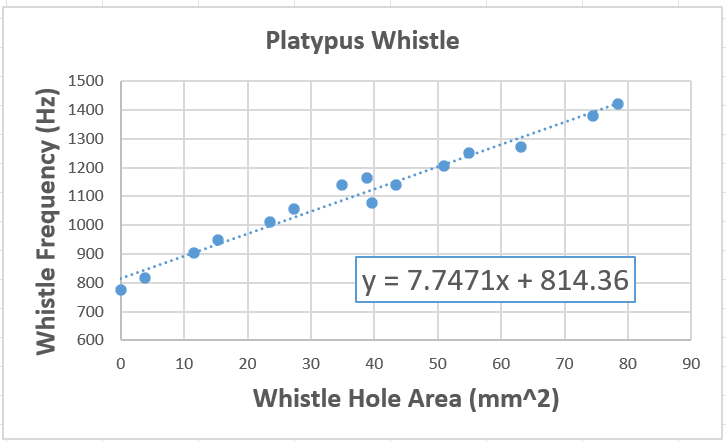
Now, we can determine the total finger hole size required to change the whistle pitch by 1 octave. What is an octave? It's simply a range of pitches between pitch P and pitch 2 times P. The classic Do-Ra-Me-Fa-So-La-Te-Do is 1 octave of pitches where the low-Do has a pitch P and the high-Do has a pitch of double P with 6 equally space pitches in between low-Do and high-Do. For example, Do-Ra-Me-Fa-So-La-Te-Do could have the frequencies of 500, 570, 640, 710, 780, 870, 930, and 1000 Hz
We take our Platypus whistle data and change with Y-axis at represent the "ratio of the frequency to the whistle's base pitch".
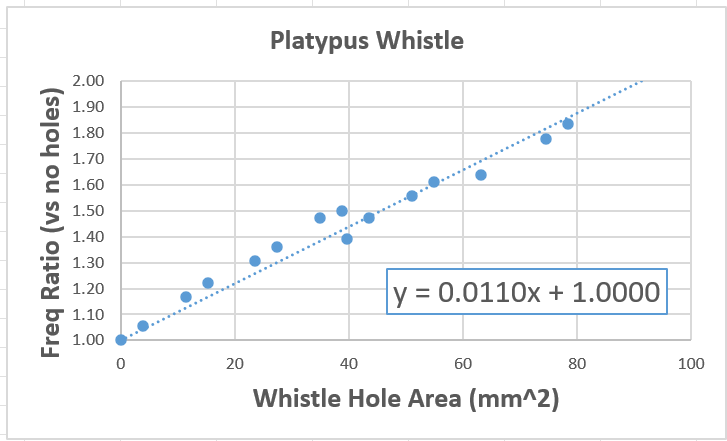
We have our straight line fit to the data with a slope of 0.0110 per square millimeter. In other words, we have 1/(0.0110) or we need finger holes with a total area of 91 mm^2: a hole with an diameter of 11 mm (a bit under 1/2 inches).
But Wait!!!!!!
This result is for Platypus Whistle which is a smallish size.
Can we generalize this result for any sized whistle?
Collecting of the data from our 5 whistles, here is a graph showing a linear relationship between the "radius of a finger hole to change the whistle pitch by 1 octave" and the "interior volume" of the whistle:

Example:
I have molded a clay whistle that has an interior volume of 27 cc's.
The cube-root of my volume is 3 (units = funny).
The base-pitch of the whistle will be 2085.4 / 3 = 695 Hz.
I want my whistle to span 1 octave from 695 Hz to 1390 Hz.
The total finger hole area octave is pi*(4.1229 * 3)^2 = 480 mm^2.
I want my notes to be simple Do-Ra-Me-Fa-So-La-Te-Do, 8 distinct notes, and each note is separated by a change of area of (489mm^2)/7 = 70 mm^2.
The easiest way to do this is to make 7 finger holes where each is 70 mm^2 (or a diameter of 9.5 mm or 0.38 inches).
How about using 4 holes, holes 1 thru 4, where that number represents their area.:e.g., hole 1 has an area of A, hole 2 = 2A, hole 3 = 3A, & hole 4 = 4A.
Open Holes Total Area
1 = A
2=2A
3=3A
4=4A
1&4=5A
2&4=6A
3&4=7A
1&3&4=8A
So, we can use 4 holes to tune our whistle where the diameters of the holes are 9.5mm, 19mm, 28.5mm, and 38mm.
Remember, the size of the clay whistle will decrease about 11% during the entire firing process (so a volume reduction of about 33%). The finger holes' area will decrease by about 22%, though! It might be a good idea to place a "Re-Tuning Slit" into the clay body prior to firing your whistle: see the previous webpage under "Tuning Your Whistle".
If you have any comments or suggestions on making whistles and ocarinas, send me an email at